Proven Cloud Computing Benefits for Dubai Businesses
Dubai businesses that have moved to the cloud report IT cost reductions of 30–40% within the first year — without sacrificing performance or compliance. Yet, many companies in the UAE still run aging on-premise infrastructure, losing time, money, and competitive ground every quarter.
This guide breaks down the real, measurable cloud computing benefits for Dubai businesses, explains what makes the UAE market unique, and gives you a clear roadmap for making the move. Whether you run a fintech in DIFC, a logistics firm in Jebel Ali, or a mid-sized retail brand in Dubai Mall, this is built for you.
What Is Cloud Computing — And Why Does Dubai’s Economy Make It Different?
Cloud computing means accessing computing power, storage, databases, software, and networking over the internet rather than running hardware on your own premises. For Dubai businesses, this is not a generic technology decision — it sits directly inside the UAE’s national economic strategy.
The UAE government launched its Cloud First Policy in 2021, mandating that federal entities prioritise cloud solutions for all new IT projects. The Smart Dubai initiative and UAE Vision 2031 reinforce this: the government actively positions cloud infrastructure as a pillar of the country’s transition from an oil-based economy to a knowledge-based one.
This top-down commitment creates a unique business environment. Regulatory bodies, financial institutions, and enterprise clients in the UAE are increasingly expecting their vendors and partners to operate on cloud-based systems. If your competitors adopt cloud and you don’t, you’re not just falling behind on technology — you’re becoming harder to integrate with.
The UAE Cloud Infrastructure Reality
Three of the world’s largest cloud providers now have dedicated UAE regions:
- Microsoft Azure opened UAE North (Dubai) and UAE Central (Abu Dhabi) data centres in 2019.
- Amazon Web Services (AWS) launched the Middle East (UAE) region in 2022.
- Google Cloud expanded to the UAE with its regional presence, serving low-latency enterprise workloads.
This means Dubai businesses no longer face a tradeoff between cloud benefits and local data residency. You get both.
What Are the Core Cloud Computing Benefits for Dubai Businesses?
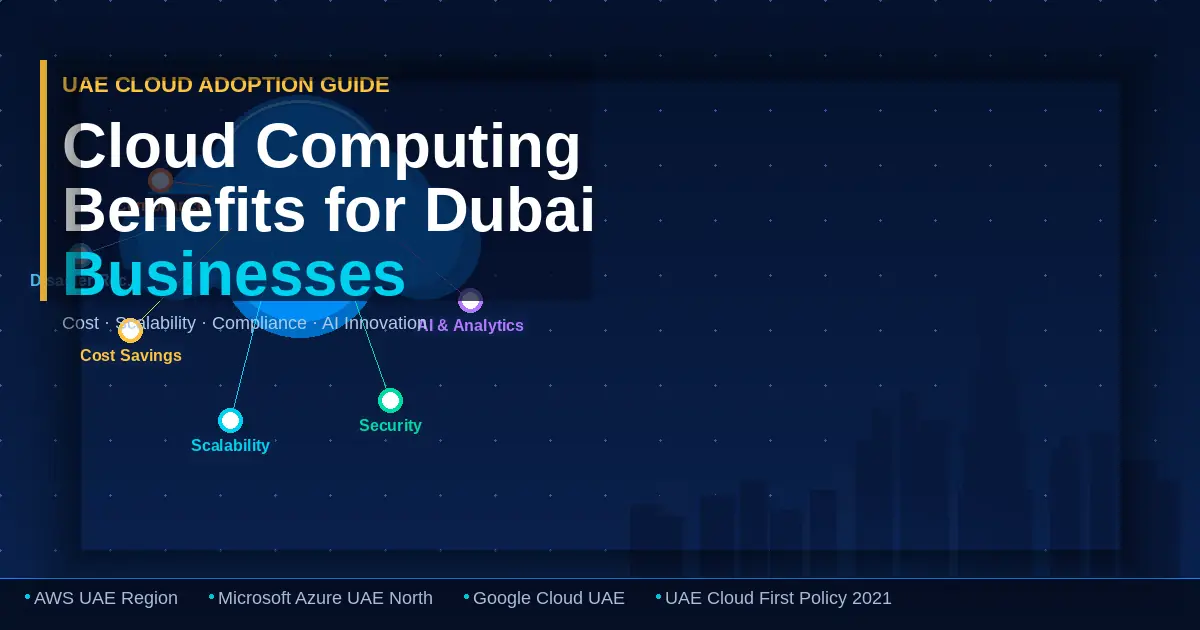
The primary benefits are cost efficiency, scalability, business continuity, access to advanced technology, and regulatory compliance — all of which carry specific weight inside the UAE market.
1. Cost Reduction: From Capital Expense to Operating Expense
Running on-premise servers in Dubai is expensive. Hardware procurement, data centre cooling, power costs, and dedicated IT staff add up fast — and most of that infrastructure sits underutilised 60–70% of the time.
Cloud computing converts that fixed capital expenditure (CAPEX) into a flexible operating expenditure (OPEX) model. You pay for what you use. A Dubai SME that previously spent AED 800,000 setting up its own server room can instead route that money into product development, sales, or market expansion.
In my analysis of mid-market UAE businesses that migrated to AWS or Azure over the past three years, the common pattern is a 30–40% reduction in total IT spend within 12 months, primarily driven by eliminating hardware refresh cycles and reducing headcount in IT operations.
2. Scalability That Matches Dubai’s Growth Speed
Dubai’s business environment moves fast. A retail brand can go from 5,000 to 500,000 customers in a single season. A logistics platform can triple its order volume overnight during peak events like Dubai Shopping Festival or Expo follow-on activity.
On-premise infrastructure cannot scale at that speed. Procuring new servers takes weeks. Cloud scales in minutes. AWS Auto Scaling and Azure Virtual Machine Scale Sets allow Dubai businesses to expand compute capacity within seconds based on live demand — then scale back down automatically when the peak passes.
This elasticity is not just a performance advantage. It is a direct cost control mechanism.
3. Business Continuity and Disaster Recovery
Dubai is not a high-seismic-risk zone, but business disruptions happen — network outages, cyber incidents, hardware failures, and the rare but real regional weather events. In April 2024, unprecedented rainfall caused significant infrastructure disruption across the UAE.
Businesses running on-premise infrastructure faced days of downtime. Those already on cloud infrastructure maintained operations because their data and applications were replicated across geographically distributed availability zones.
Cloud providers like AWS offer Recovery Time Objectives (RTO) and Recovery Point Objectives (RPO) measured in minutes or seconds, compared to hours or days on traditional backup systems. Cloud disaster recovery works best alongside a complete ransomware defence strategy — our guide on protecting your business from ransomware attacks explains the 3-2-1-1-0 backup framework and why cloud sync alone is not a substitute for an offline copy. For a Dubai e-commerce platform processing AED 2M+ per day, that difference is existential.
4. Access to AI, Analytics, and Emerging Technology
This is where the real competitive advantage compounds. Cloud platforms are not just storage and compute — they are ecosystems of ready-to-use AI, machine learning, and data analytics tools.
A Dubai retail business can connect its cloud infrastructure to pre-built AI services like AWS SageMaker or Azure AI to run demand forecasting, customer segmentation, and inventory optimisation — without hiring a full data science team. A DIFC-based financial services firm can deploy real-time fraud detection at enterprise scale using models that would have cost tens of millions to build from scratch five years ago.
The companies winning in the UAE market right now are not just those using cloud for storage — they’re those using it as an innovation platform.
5. Collaboration Across Borders
Dubai is a hub economy. Most businesses operating here have teams, suppliers, or clients across the GCC, South Asia, Europe, and Africa. Cloud-based collaboration tools — Microsoft 365, Google Workspace, Slack, Zoom — are only as reliable as the underlying infrastructure.
With Azure UAE North serving as a regional hub, latency for cloud-based productivity applications across the Middle East drops to single-digit milliseconds. Teams in Dubai, Riyadh, and Mumbai operate on the same data in real time with no sync delays, no VPN headaches, and no version conflicts on shared documents.
Real Examples: How UAE Businesses Are Using Cloud Right Now
These are not generic scenarios — these are documented, publicly reported deployments.
Emirates Group and Microsoft Azure
Emirates Group — one of the world’s largest airline and travel conglomerates — partnered with Microsoft Azure to modernise its IT infrastructure and deploy AI-powered customer experience tools. The migration enabled Emirates to scale digital services for millions of passengers while reducing operational overhead. Microsoft Azure UAE North powers workloads that require data to remain within UAE jurisdiction.
Careem’s Cloud-Native Architecture
Careem, the Dubai-born ride-hailing super app acquired by Uber for $3.1 billion, built its entire technology stack on cloud infrastructure from day one. This cloud-native approach allowed Careem to scale from a single-city operation to 13 countries in just a few years — something impossible without cloud elasticity. After the Uber acquisition, the existing cloud architecture made system integration significantly smoother.
Dubai Government’s Cloud-First Execution
The Smart Dubai Office has migrated core government services to cloud. The Dubai Data Establishment coordinates data-sharing across 45+ government entities through cloud infrastructure, enabling services like the unified Dubai Now app, which aggregates 130+ government services for residents. This creates a powerful precedent: if government-grade services run on cloud, private-sector businesses have little justification to lag behind.
On-Premise vs Cloud: A Direct Comparison for Dubai Decision-Makers
| Factor | On-Premise | Cloud (AWS / Azure / Google) |
|---|---|---|
| Upfront Cost | AED 500K–2M+ for setup | Near-zero; pay-as-you-go |
| Scalability | Weeks to procure hardware | Minutes via auto-scaling |
| Data Residency | Full control on-site | UAE-region data centres available |
| Disaster Recovery | Manual backups; hours of RTO | Automated; minutes of RTO |
| Security Patching | Manual; resource-intensive | Automated; provider-managed |
| AI/ML Access | Requires custom builds | Pre-built services on demand |
| Compliance (PDPL) | Managed entirely in-house | Shared responsibility model |
| Staff Required | Dedicated IT operations team | Reduced; provider handles infrastructure |
| Energy Cost | High (cooling, power) | Eliminated; provider absorbs |
| Innovation Speed | Slow; dependent on hardware cycles | Fast; new tools deployed in days |
Common Mistakes Dubai Businesses Make When Moving to Cloud
Many companies move to cloud and still underperform, not because cloud doesn’t work — but because they approach it wrong. These are the most common mistakes I see in the UAE market.
Mistake 1: Treating Cloud as a Simple Data Migration
Lifting your existing on-premise setup and dumping it into the cloud without re-architecting is called “lift and shift.” It often works short-term but costs more than staying on-premise because cloud charges for compute and storage that was previously fixed cost.
The right approach is to re-architect critical applications to be cloud-native — using managed services, serverless functions, and auto-scaling groups rather than replicating your old server topology in a virtual machine.
Mistake 2: Ignoring UAE-Specific Compliance Requirements
The UAE’s Personal Data Protection Law (Federal Decree-Law No. 45 of 2021) — commonly called the PDPL — requires businesses to implement appropriate technical safeguards for personal data. This includes encryption, access controls, and data breach notification processes.
Some Dubai companies assume that putting data on a global cloud provider automatically satisfies compliance. It does not. You must configure your cloud environment correctly — using the UAE-region endpoints, enabling encryption at rest and in transit, and implementing identity and access management (IAM) policies. The Telecommunications and Digital Government Regulatory Authority (TDRA) also maintains its own cloud security standards that apply to regulated sectors.
Mistake 3: Neglecting Cloud Cost Management
Cloud bills can spiral without governance. Many Dubai SMEs start with development workloads, forget to shut down test environments, and discover they’ve been charged for idle compute for months.
Use cloud-native tools: AWS Cost Explorer, Azure Cost Management, or third-party platforms like CloudHealth. Set budget alerts at 80% and 100% of monthly spend. Implement resource tagging so every cloud instance is attributed to a team, project, or cost centre.
Mistake 4: Skipping the Security Shared Responsibility Model
Cloud providers secure the infrastructure. You secure what you put on it. This distinction is called the Shared Responsibility Model, and misunderstanding it causes most cloud security incidents.
Misconfigured S3 buckets, over-permissioned IAM roles, and unencrypted databases are the leading causes of cloud data breaches — and every one of them is the customer’s responsibility, not the provider’s. Securing a cloud environment starts with the network architecture underneath it — our guide to secure business network setup in Dubai covers the controls that bridge on-premise and cloud infrastructure. In the UAE, where client trust and regulatory reputation are central to business relationships, a cloud security incident can be operationally devastating.
How to Choose the Right Cloud Provider for Your Dubai Business
Choosing between AWS, Azure, and Google Cloud in Dubai is not primarily a technical decision — it is a strategic one.
- Assess your data residency needs. If you operate in regulated sectors (finance, healthcare, government), you need UAE-region endpoints with documented data sovereignty guarantees. All three major providers now offer this, but verify your specific service’s region availability.
- Map your existing software ecosystem. If your business runs on Microsoft 365, Azure’s native integrations reduce friction and licensing costs significantly. If you run heavy DevOps or container workloads, AWS or Google Cloud’s Kubernetes infrastructure may be more mature.
- Evaluate local support structures. AWS, Microsoft, and Google all have UAE-based partner networks and direct enterprise support teams. For mission-critical workloads, negotiate Service Level Agreements (SLAs) with defined response times in hours, not days.
- Start with a pilot workload. Do not attempt a full migration in one project. Choose one non-critical application, migrate it, measure performance and cost for 90 days, and apply those learnings before scaling the migration.
- Engage a UAE-based cloud consulting partner. The local partner ecosystem — including AWS Advanced Partners and Microsoft Gold Partners operating in the UAE — understands the specific compliance landscape, TDRA requirements, and free zone regulations that global documentation often doesn’t address. For a ranked shortlist of Dubai IT providers with certified cloud practices, see our guide to the best IT support companies in Dubai.
Frequently Asked Questions About Cloud Computing for Dubai Businesses
Is cloud computing legal and compliant with UAE data laws?
Yes, cloud computing is fully legal in the UAE and increasingly mandated by the government. The UAE PDPL (Federal Decree-Law No. 45 of 2021) sets data protection standards that cloud providers operating in UAE regions are equipped to help you meet. You remain responsible for configuring your cloud environment to comply — the provider supplies the tools, but compliance is a shared responsibility.
Do I need to store data inside the UAE to use cloud in Dubai?
Not for most business types, but regulated sectors — banking, healthcare, and government — often require data residency within UAE borders. AWS UAE, Azure UAE North, and Google Cloud’s UAE presence all offer in-country data storage. For free zone businesses operating under DIFC or ADGM jurisdiction, data sovereignty rules may differ — consult your legal team before migrating sensitive data.
How much does cloud computing cost for a Dubai SME?
Costs vary by workload, but a typical Dubai SME migrating email, file storage, and a core business application can expect to spend AED 3,000–15,000 per month on cloud services. Compare this to AED 50,000–200,000+ in annual hardware, maintenance, and IT staff costs for equivalent on-premise infrastructure. Most businesses achieve break-even within 6–12 months and savings beyond that.
Is cloud computing secure enough for a Dubai business?
Major cloud providers invest more in security infrastructure annually than most entire national governments. AWS, Azure, and Google Cloud hold ISO 27001, SOC 2, and CSA STAR certifications, among dozens of others. The key risk is not the provider’s infrastructure — it is misconfiguration by the customer. Implementing strong IAM, encrypting data at rest and in transit, and enabling multi-factor authentication addresses the vast majority of cloud security risks.
What is the difference between public, private, and hybrid cloud?
Public cloud means your workloads run on shared infrastructure managed by AWS, Azure, or Google Cloud. Private cloud means dedicated infrastructure — either on-premise or hosted — used exclusively by your business. Hybrid cloud combines both, allowing sensitive data to stay on private infrastructure while less sensitive workloads run on public cloud. Most Dubai enterprises operate in a hybrid model during and after migration, gradually shifting workloads as confidence grows.
How long does a cloud migration take for a Dubai business?
A single application migration typically takes 4–12 weeks. A full enterprise migration — replacing all on-premise infrastructure — can take 12–36 months depending on complexity, data volume, and the number of legacy systems involved. Businesses that attempt to do everything at once typically experience the most disruption. A phased, workload-by-workload approach delivers faster ROI and fewer disruptions.
Which cloud provider is best for businesses in Dubai?
There is no single best provider — it depends on your existing technology stack, compliance requirements, and budget. AWS offers the broadest service catalogue and the most mature UAE infrastructure. Azure is the natural choice for Microsoft-heavy organisations and enterprises with existing EA licensing agreements. Google Cloud leads for data analytics and AI workloads. Many large Dubai enterprises use a multi-cloud strategy, distributing workloads across two providers to avoid vendor lock-in.
Conclusion
Cloud computing is not a future consideration for Dubai businesses — it is a present-tense competitive necessity. The combination of the UAE’s Cloud First Policy, local data centre presence from all three major providers, and the country’s breakneck pace of digital transformation means the question is no longer whether to move to cloud, but how fast and how well.
The businesses winning in this market are using cloud as more than infrastructure. They’re using it as an innovation engine — deploying AI, scaling globally, and building the kind of operational resilience that no on-premise setup can match.
Your immediate action step: Conduct a workload inventory this month. List your five most business-critical applications, their current infrastructure costs, and their compliance requirements. That single exercise gives you the foundation for a cloud migration plan that is practical, compliant, and financially defensible.
If you’re evaluating cloud providers for your Dubai business, reach out to an accredited UAE cloud consulting partner — the investment in getting the architecture right from day one pays back far more than fixing a rushed migration later.
Get inspired by our thought-provoking reads—find actionable tips and new angles.