Top Cyber Security Threats for Small Businesses in UAE (2026 Guide)
More than 45% of organizations in the UAE reported a cyberattack in the past year, and small businesses are now the easiest targets because they often skip basic protections like multi-factor authentication. If you run an SME in Dubai, Abu Dhabi, or Sharjah, the threats below are the ones actually hitting companies like yours right now — not theoretical risks from a vendor brochure. This guide breaks down each threat, why it works, and what to do about it.
What Is the Biggest Cyber Security Threat to Small Businesses in UAE?
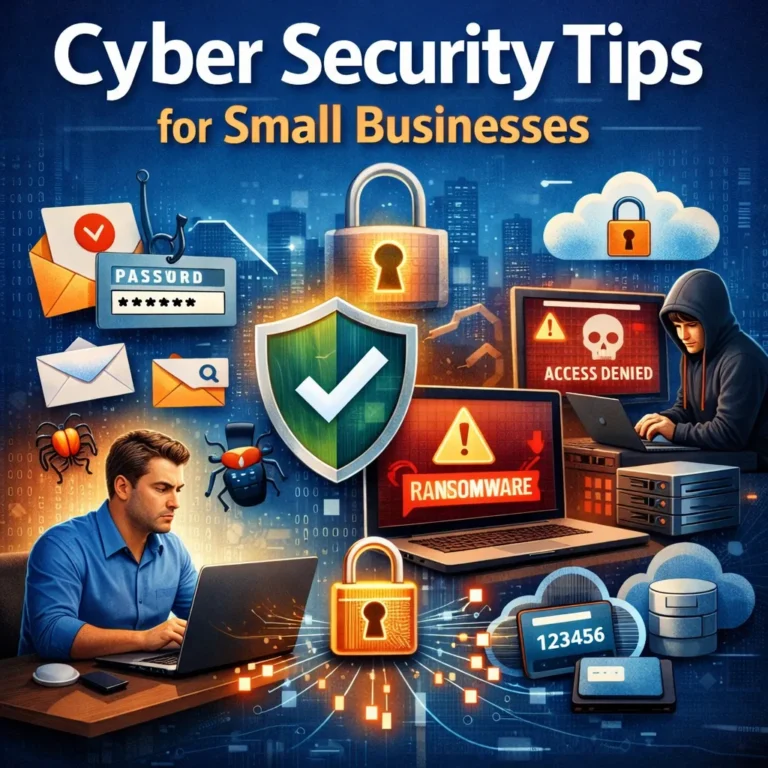
Ransomware remains the single most damaging threat facing UAE SMEs in 2026. Attackers break into a network, encrypt company files, and demand payment for the decryption key — often while threatening to leak stolen data if you refuse. For a 20-person company with no backup plan, this can mean days or weeks of total shutdown.
I’ve reviewed incident reports from regional security firms, and the pattern is consistent: ransomware doesn’t usually start with a sophisticated exploit. It starts with one employee clicking a bad link, or a remote desktop port left open to the internet. Regional threat trackers recorded a 32% year-over-year jump in ransomware activity, which tells you this isn’t slowing down — it’s accelerating as attackers automate more of the process. For a step-by-step defence framework covering backup strategy, MFA, EDR, and incident response, see our guide on protecting your business from ransomware attacks.
Small businesses are attractive ransomware targets for three specific reasons:
- They typically don’t have a dedicated IT security team monitoring systems 24/7.
- They’re more likely to pay quickly because downtime hurts cash flow immediately.
- They’re often connected to larger partners or clients, making them a stepping stone into bigger networks.
The UAE’s Cyber Security Council has reported that roughly half of known vulnerabilities sitting on UAE business networks are more than five years old. That’s not a technology gap — it’s a maintenance gap, and it’s exactly what ransomware groups scan for.
How Do Phishing and Business Email Compromise Scams Actually Work?
Phishing succeeds by targeting people, not technology, and it’s the most common entry point for every other attack on this list. Attackers send fake emails that look like they’re from a bank, supplier, or colleague, tricking someone into entering a password or approving a payment. Business Email Compromise (BEC) takes this further by impersonating a real executive or vendor to redirect a wire transfer.
In my own work reviewing client security setups across the Gulf, the BEC cases I see follow a near-identical script: an “urgent” email lands on a Friday afternoon, appears to come from the founder or finance director, and asks for a payment to be rushed through before a deadline. The email address is almost right — one letter off, or a different domain extension. Regional data shows email impersonation attacks rose by roughly 75% in a single year, which is a much sharper increase than ransomware itself.
A few things make UAE businesses specifically vulnerable here:
- Cross-border transactions are routine. International wire transfers in multiple currencies make a fraudulent payment request look normal rather than suspicious.
- Attackers now use AI to write better emails. Generic “Dear Customer” scams have largely been replaced by messages that reference your actual job title, a real project, or a recent LinkedIn post.
- Approval processes get bypassed under urgency. A message marked “urgent — confidential” pressures staff to skip the usual sign-off chain.
The fix isn’t complicated, but it has to be enforced, not just written into a policy document: verify any payment change request by phone, using a number you already have on file — never a number provided in the email itself.
What Cyber Security Mistakes Are Most UAE Small Businesses Making?
The biggest mistake isn’t a lack of tools — it’s leaving basic identity protections turned off. Industry survey data from 2026 found that more than 45% of UAE organizations still haven’t adopted multi-factor authentication (MFA) or a password manager, and over 40% have no identity and access management system at all. Meanwhile, 96% of those same companies believe they already have the tools needed to respond to an attack. That gap between confidence and actual readiness is where most breaches happen.
Here’s a quick comparison of what “basic protection” looks like versus what most UAE SMEs currently have in place:
| Security Control | Recommended for SMEs | Common Reality (2026 data) |
|---|---|---|
| Multi-factor authentication | Enabled on all accounts | Missing at 45%+ of UAE organizations |
| Identity & access management | Role-based access enforced | Absent at 40%+ of organizations |
| Data backups (tested) | Daily, with offsite copy | Often missing or untested |
| Employee phishing training | Quarterly simulations | Ad hoc or one-time only |
| Patch management | Automated, within days | Patches often years overdue |
A few other recurring patterns worth flagging:
- Weak remote access. Staff connect to company systems over personal devices or unsecured Wi-Fi, with no VPN or conditional access policy in place.
- No role-based access control. Every employee can see far more company data than their job actually requires, so one compromised account exposes everything.
- Treating cybersecurity as a checkbox. Some businesses buy a security tool to satisfy a client or partner requirement, then never configure it properly.
- No incident response plan. When something does go wrong, there’s no clear process for who shuts down what, or who gets notified first.
None of this requires enterprise-level budget to fix. MFA, in particular, blocks the overwhelming majority of credential-based attacks and costs nothing to switch on for most Microsoft 365 or Google Workspace accounts. The next protection layer is endpoint security — our comparison of best antivirus software for UAE small businesses identifies which solutions work best for SMEs without a dedicated IT team.
What New Cyber Threats Should UAE Businesses Watch in 2026?
Three threats are growing faster than traditional ones this year: AI-powered social engineering, “shadow AI” data leaks, and deepfake voice/video fraud. Each one exploits a gap that didn’t really exist five years ago — and traditional antivirus tools weren’t designed to catch any of them.
AI-generated phishing and “shadow agents.” Attackers now use generative AI to produce flawless, personalized phishing emails in seconds, removing the spelling mistakes and awkward phrasing that used to be a warning sign. Security researchers are also tracking the rise of “shadow agents” — AI tools employees connect to company systems without IT approval, creating unmonitored access points.
Deepfake voice and video calls. Because so much UAE business is conducted over voice and video rather than in person, deepfake audio impersonating a CEO or supplier on a call is becoming a real operational risk, not just a theoretical one. Forrester has flagged 2026 as a turning point where standard voice verification can no longer be trusted on its own.
Third-party and supply chain risk. Roughly 29% of all data breaches now involve a third-party vendor rather than a direct attack on the company itself. If your accountant, marketing agency, or software vendor gets breached, your data can be exposed even if your own systems were never touched.
Operational technology (OT) targeting. For UAE businesses connected to energy, utilities, or logistics supply chains, regional threat intelligence has flagged increased interest from state-linked actors in industrial control systems — a risk that didn’t used to apply to small operators but increasingly does as supply chains digitize.
Common Mistakes and Myths About Cyber Security for UAE SMEs
The most damaging myth is that small businesses are “too small to be a target” — in reality, size is exactly why attackers prefer them. Attackers run automated scans that don’t care about company size; they care about which doors are unlocked.
A few other myths worth retiring:
- “We have antivirus, so we’re covered.” Antivirus catches known malware signatures. It does nothing against a stolen password used to log in legitimately, which is how most modern breaches start.
- “Cyber insurance means we don’t need prevention.” Insurers increasingly require proof of MFA and backups before they’ll even issue a policy, let alone pay out a claim.
- “It’s an IT problem, not a leadership problem.” Budget and policy decisions — like whether MFA is mandatory — are made by leadership, not IT staff alone.
- “We’ll notice if we’re breached.” Many ransomware groups now sit inside a network for days or weeks, quietly stealing data before triggering the encryption that makes the attack visible.
Frequently Asked Questions
What is the most common cyber attack on small businesses in the UAE? Phishing is the most common attack, since it’s the easiest way for attackers to steal a password or trick an employee into approving a fraudulent payment. Most ransomware and Business Email Compromise incidents trace back to a phishing email as the starting point.
Why are small businesses targeted more than large companies? Small businesses usually have fewer dedicated security staff, slower patching, and weaker access controls, making them easier to breach. Attackers also use SMEs as a stepping stone to reach larger partners or clients in the same supply chain.
Is multi-factor authentication really necessary for a small business? Yes — MFA blocks the vast majority of password-based attacks for little or no extra cost. Despite this, more than 45% of UAE organizations still haven’t enabled it across their accounts.
How much does cybersecurity cost a small business in the UAE? A full security stack can take up 12% of an SME’s IT budget, but the essentials — MFA, backups, and staff training — cost far less and prevent most common attacks. Many providers now offer subscription-based packages designed specifically for smaller budgets.
What should I do immediately after a ransomware attack? Disconnect affected devices from the network immediately to stop the spread, then contact a UAE-licensed incident response provider before considering any ransom payment. Report the incident to the relevant UAE authority, since cybercrime is governed under Federal Decree Law No. 34 of 2021.
Do UAE data protection laws apply to small businesses? Yes — data protection obligations under UAE federal and free-zone frameworks generally apply regardless of company size, especially if you handle customer payment or personal data. Non-compliance can carry regulatory penalties on top of the breach itself.
Can a small business survive a major data breach? Many can, but recovery often takes months and depends heavily on whether tested backups and an incident response plan existed beforehand. Businesses without backups face far higher rates of permanent closure after a serious ransomware incident.
Final Thoughts: Start With the Basics, Not the Budget
Most UAE small businesses don’t get breached because of an exotic, unstoppable attack — they get breached because MFA wasn’t switched on, a backup was never tested, or one employee clicked a convincing email. Fixing the fundamentals covered in this guide closes the door on the vast majority of attacks hitting SMEs in the region today.
Action step: Pick one control from the table above that your business doesn’t have yet — most likely MFA — and turn it on this week. It’s the single highest-impact, lowest-cost change you can make right now.
Explore fresh, value-driven content—start reading and stay ahead in your game.